Rabbit Holes · 30 December 2025
Last issue!
The Jew clause, Christmas services and a poor parish clerk, lazy boys and drunkards.
In the last issue we looked at several antisemitic pieces (one of those mentioned replies in this issue), went down a little rabbit hole around primstaves and calendars (and apostles in India), and learned a bit about local democracy.
And in this issue we finish a project that has lasted a year, 37 issues have brought political news, high-flown poetry, beautiful speeches, war and ceasefire, and lots of odd and interesting notices. From 6 January when I started, until today, I've learned a whole lot, and I'm very grateful to those of you who have chosen to follow the journey, it's been motivating and fun to write in order to share with someone else.
So with this issue the reading of newspapers ends, I made it to the finish (against all odds!) before New Year and I won't be continuing into 2026. However, I'm not quite done with this project yet – I had decided not to read any history books about 1814 until I was finished with the year, to “let myself be surprised” by the news as it came (and that has happened, and kept it exciting). Now I have a list of books and sources I want to look at more closely – it'll be exciting to see how my impression, shaped through the newspapers, matches or doesn't match what the historians give us, with their access to archives, diaries and context.
I also have some thoughts on ways I can build on all the content I've produced. But everything I've written will stay up, and I hope more people interested in history will discover it. So there might be a couple more posts on this mailing list eventually. But my big project for 2026 also has to do with old texts, though in a pretty different way. I'm going to read the entire Old Testament, and for each month find different cultural expressions inspired by stories and verses. I've “jumped the gun”, and have already seen operas and read novels and plays about Cain and Abel, the Creation, Abraham etc. If you want to follow along on that journey, I'll be posting on Kulturelle kaninhull og røde tråder. Hope to see you there.
Foreign news
In Vienna the negotiations continue, a big question is the future of Germany. Even though the main question is still difficult, a lot of positive details are coming out on the smaller questions. The German book trade can look forward to better regulation, and State Chancellor Hardenberg has declared himself very warmly in favor of unrestricted freedom of the press.
The representatives of the Jews have also been well received, and there are several important people who take an interest in their nation. Since the Jews in the Prussian states have long had civil rights, the general principles should surely not allow measures by which the liberal prospect that has already opened up could disappear. The nation still has its open, fierce and considerable opponents, though. (Under Napoleon, Jews got equal rights with others in many places, the question here is what should happen next).
In Paris prizes of 3000, 2000 and 1000 francs are being awarded to the doctors who give the most smallpox vaccinations.
Pastor Wulfsberg and Tiden
The newspaper Tiden has been the most readable paper all year, with the most interesting political news, including direct reports from the negotiations in the Constituent Assembly. It has been run by pastor Niels Wulfsberg. He has now stepped down, and in 1815 he'll start as national archivist in Stockholm and teacher for Oscar, the crown prince's son. So we're informed about the new editor of Tiden, senior teacher Christian Døderlein, and we see an ad for the auction of Wulfsberg's property (since he's moving), which has 11 rooms with tiled stoves, 6 cellars, a kitchen and a brewhouse, a whole bunch of lofts, running water whose fees and upkeep are paid by the owner of the neighboring property, according to contract. The property includes a pretty little garden with some fruit trees, a sizable courtyard and a gate to two streets. (*)
Christmas
There's been incredibly little about Advent, Christmas or New Year in the papers. I understand that many of today's Christmas traditions came later than 1814, and a lot of what actually happened (which you saw a bit of when I read about primstaves and beer brewing and such in the last issue) were things that didn't necessarily have to be written about in the papers. But I might have expected a few more ads for Christmas things for sale, various get-togethers etc. Though we did read in the last issue that julebukk (Christmas mumming) was strictly forbidden…
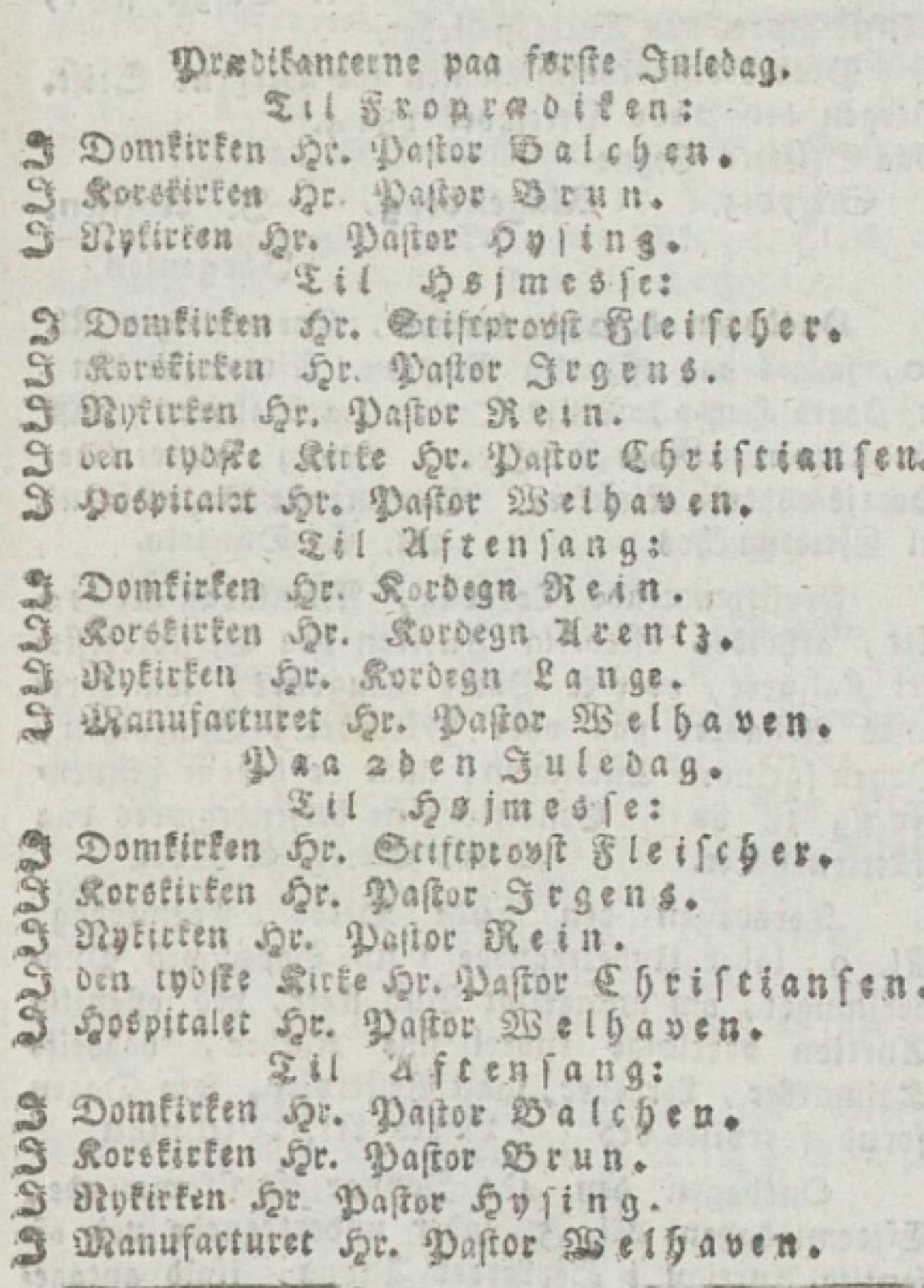
But on 24 December (the paper actually comes out that day), we get an overview of everyone who's going to preach on Christmas Day (apparently that was the big church day back then). In Bergen we're talking morning mass, high mass, evensong, and high mass and evensong on the 2nd day. And we have Domkirken, Korskirken, Nykirken, the German church, the Hospital and in Manufacturet. (Manufacturet was a kind of prison/workhouse where people worked and produced things). (*)
In the same paper there's a curious notice from a poor kordegn (a kind of senior parish clerk):
Since I have come to learn that a number of families in the Korskirken congregation, in the 7 years I have been kordegn at the church, have not given me an offering at any holy day, I believe that this is due to the ignorance of those concerned of my right to the same. I must therefore be permitted, once, to make it publicly known that I, according to the royal ordinances, am entitled to enjoy offerings from the congregation at the holy days.
As far as I understand the law at this time was that people employed by the church didn't get a full salary from the state, but depended both on payment for services performed (weddings, funerals, baptisms etc), but also on offerings from the congregation at certain holy days.
The Jew clause
In the last issue a man called Francke was accused of having been a Jew in Copenhagen, and of staying in Norway despite the constitution, which bans Jews from being in the country (unless he has converted to the Christian faith?). Now Francke replies, he's sorry that he didn't know that the constitution's clause also covered shorter business trips, and apart from that he hasn't done anything wrong other than (still) being a Jew. He hopes nothing bad will happen to his friends and business contacts in Norway. (*)
The union of the North
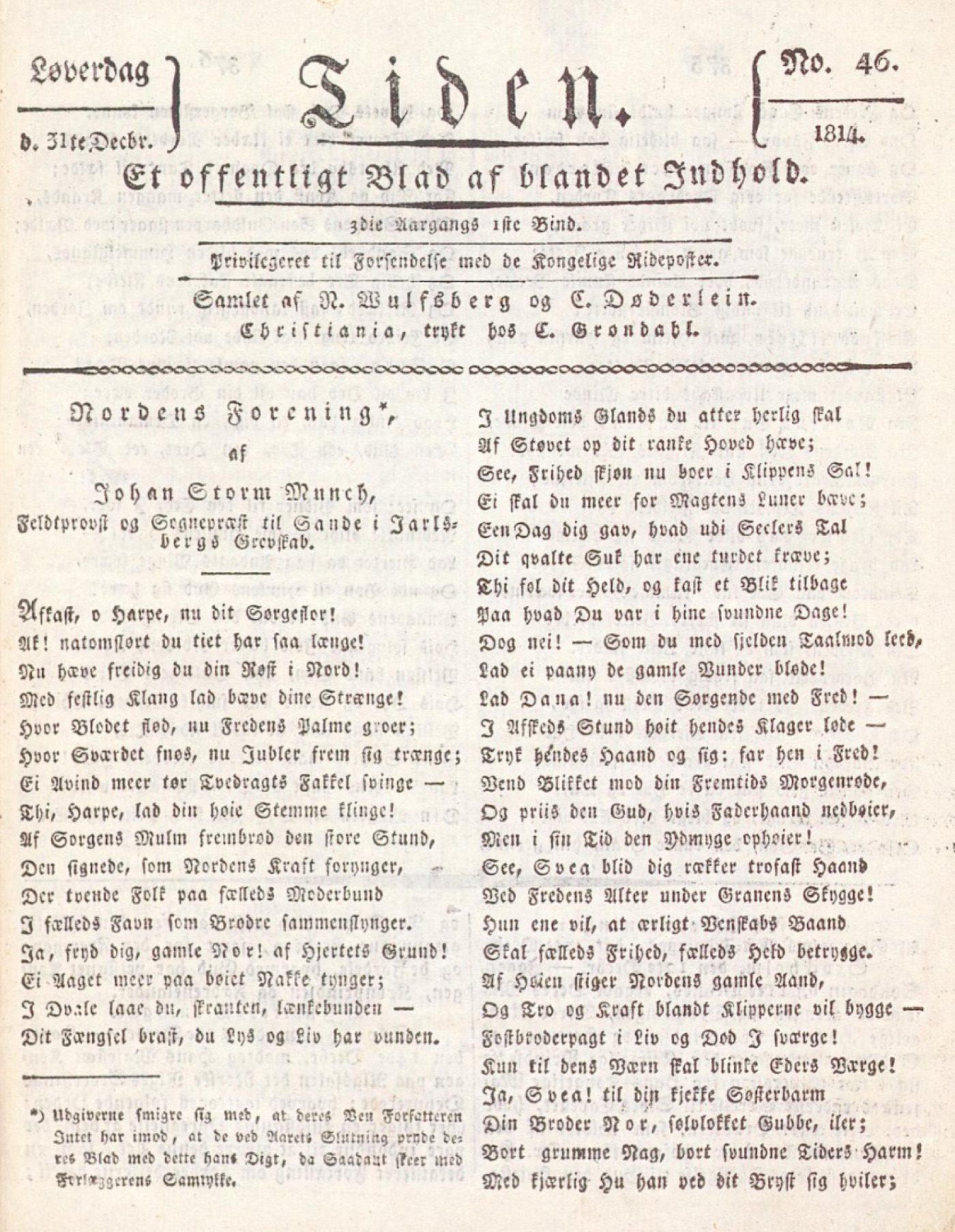
The last paper of the year devotes most of its content to printing a long poem about the union of the North. So the least we can do is reproduce it here. It was written by Johan Storm Munch, a priest and friend of the union who had already published poetry collections and who would later translate saga literature from Old Norse. His son Andreas Munch would become an important Norwegian poet.
Cast off, O harp, your veil of sorrow now!
Ah, shrouded in night you have been silent so long!
Now lift your voice boldly in the North!
Let your strings tremble with a festive sound!
Where blood flowed, now the palm of peace grows;
Where the sword snorted, now cheers press forward.
No more does envy dare to swing the torch of discord —
So, harp, let your high voice ring out!From sorrow's gloom the great hour broke,
The blessed hour, which renews the strength of the North,
When two peoples on common mother ground
Are twined as brothers in a common embrace.
Yes, rejoice, old Nor! from the bottom of your heart!
The yoke no longer weighs on your bent neck;
You lay in torpor, sick, bound in chains —
Your prison burst, you have won light and life.In the glow of youth you shall once more, gloriously,
Raise your upright head from the dust;
See, fair freedom now lives in the hall of the rock!
No more shall you tremble at the whims of power;
One day gave you what, through a count of centuries,
Your stifled sigh alone had dared to ask;
So feel your fortune, and cast a glance back
At what you were in those vanished days!But no! — As you suffered with rare patience,
Do not let the old wounds bleed anew!
Leave Dana now, the mourner, in peace! —
In the hour of parting her laments ring loud —
Press her hand and say: go in peace!
Turn your gaze to the dawn of your future,
And praise the God whose fatherly hand bows down,
But in his time raises up the humble!See, gentle Svea holds out a faithful hand to you
At the altar of peace in the shadow of the spruce!
She wants only that the bond of honest friendship
Shall secure common freedom, common fortune.
From the mound the old spirit of the North rises,
And faith and strength will settle among the rocks —
Swear a pact of sworn brothers in life and death!
Only in its defense shall your blades flash!Yes, Svea! to your brave sisterly breast
Your brother Nor, a silver-locked old man, hurries;
Away with cruel grudges, away with the anger of times gone by!
With loving mind he rests on your breast;
And the angel of peace gently winds his arm
Around your embrace; — so tenderly he smiles
And, moved, blesses the reconciliation in the North,
Fanning away forever the thunder of discord.No longer does the Kjølen, wrapped in gray clouds,
Stand threatening like a cruel and bitter giant;
Its abysses, where envy's dark brink lay,
Are leveled out into a lovely plain of flowers;
No longer does Fredriksten, in helmet and armor,
Dare now to stir up bloody strife;
No longer stands the bitter memory of enmity
From the North Cape to the high peak of Kullen.From the coast of the North the storms of war shall flee!
United strength will shield its sanctuary;
To the temple of peace in the shelter of the mountain
Europe's wild strife dare not come near;
Let the black cloud of discord crash all around!
All around at sea let cruel hordes swarm —
See, the blue wave spreads its strong belt
Around the rock that guards the sheltered valleys.Now civic happiness shall flourish so richly
From the labor of peace in the twin kingdoms of the North,
And the treasure of the rock, from the mountain's deep hall,
Shall rise shining into the eye of day;
Golden diligence shall cover hill and dale
With golden fruit, and pale want shall give way;
Even the mountain's son, the tall spruce, the green one,
And the depths of the sea shall reward the citizen's toil.The mind of the North clings not to dust alone;
With earnest gaze it will fell the vanity of the day;
For wit and art it braids many a wreath,
While the son of song strikes the golden harp with might;
And the light of truth, with gentle heavenly glow,
And holy faith shall shine on its mountains;
And justice, nearly exiled all around the earth,
Shall find a safe refuge in the North.O Svea, embrace the old warrior Nor!
In life and death he will be your brother;
What binds him to you? A diamond belt:
“One God, one faith, one king, one blood, one honor!”
And see: as witnesses to the oath you swore,
The bright hosts of heaven sparkle gently down! —
So let the heart soar on the wing of devotion,
And rise in prayer to the God of heaven!God of all grace! Preserve the gentle old man
Whose silver-gray head bears the crown of the North!
Bless his son, your mighty one in battle,
Whose virtue and strength shall adorn the throne of the North!
Bless his line, that until the last of days
Its scepter may rule the zone of the North!
Let the pact of the North be confirmed by you!
Yours is the power, to you be praise, glory and honor!
Other
The editor of Bergensavisen has come to learn that his papers are being lent out illegally, so that he's losing money in his trade this way. Those doing it must stop, otherwise they risk being charged and having their names made public under the title of receivers and thieves.
He says that subscribers lending out papers can't be forbidden, but when servants lend them out, anyone must realize that it's illegal. To prevent this he'll stop putting out the papers on Friday evening, and deliver them on Saturday morning instead. (*)
That Martinus Valsæt gets excluded from Sunday school because of unannounced, deliberate absence and laziness is one thing, but do they have to announce it in the paper too? (*)

Speaking of being publicly shamed, that also applied to the son of master chimney sweep Styben, but this time with the best of intentions. Styben wanted to get his son, a drunkard, back on track and keep him out of bad company, so he let him work for him, but asked everyone not to pay the son directly: (*)
I hereby ask all the residents of the town, and in Østerbyen, where I may have to send my son Hans Hendrich Styben to do his work in my trade of sweeping, not to pay him for the work. I likewise ask that no one give him credit on my account, or on his own, since I will not stand good for any payment; and anyone who gives him credit must bear the loss themselves.
Nor may anyone accept any kind of pledge from him or buy anything from him, since I – if I get wind of anyone dealing with him in this way – will take it back without any payment. I am forced to do this in order, if possible, to keep him away from bad company, and to wean him off the abominable drunkenness, which sets both me and himself back a great deal.
Kristiansand, 28 December 1814. J. H. Styben, master chimney sweep.
Further
Latest in Bildung journey The reading list for Bildung journey →
Linked fromHow to get started